An Art Day in Baden-Baden:
Simon Hantaï at the Museum Frieder Burda and “Bloom up!” at the Kunsthalle
I don't always find modern art easy to get into. I'm no expert myself, and sometimes I stand in front of a painting and wonder what it's trying to tell me. At the exhibition “Entfaltung der Farbe” (“The Unfolding of Colour”) at the Museum Frieder Burda, it was different.
I went with my husband and our son Johannes, and all three of us understood straight away what it was about – before we had even read the texts on the walls. That's what I love most about this exhibition: it speaks to everyone, on very different levels.
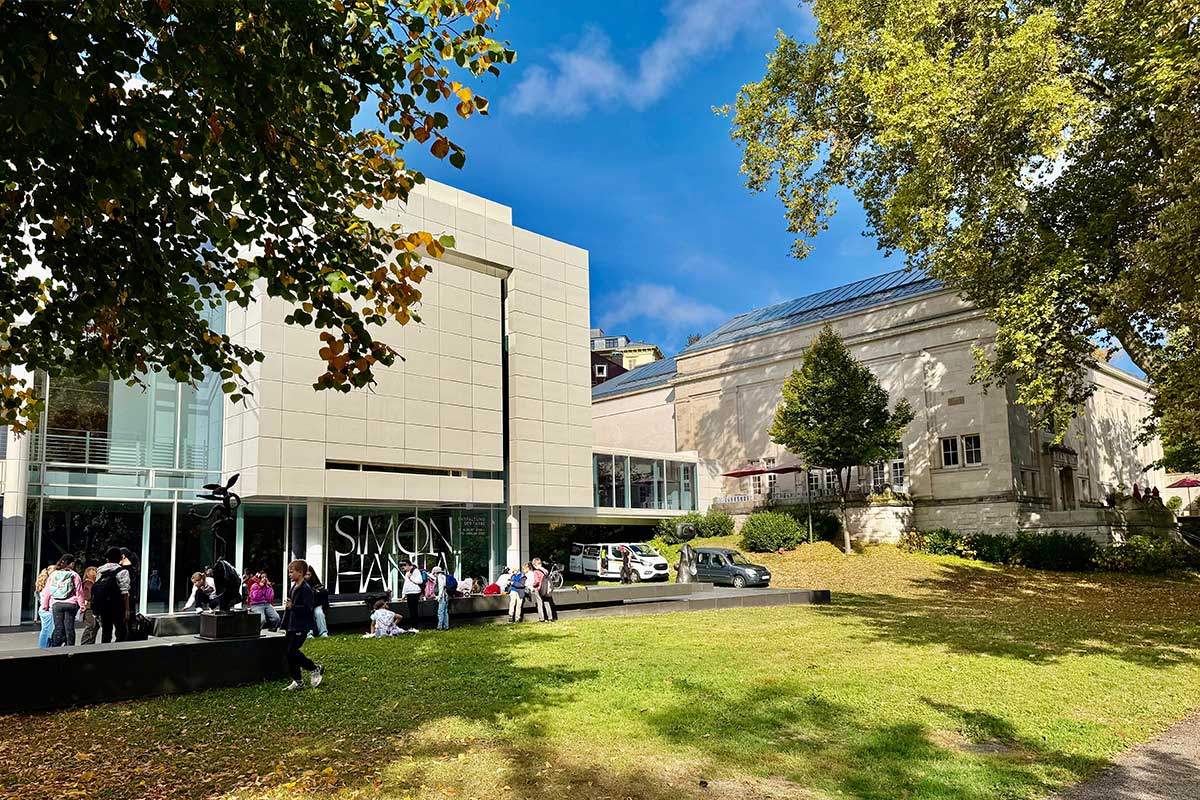
Right next door, at the Staatliche Kunsthalle, “Bloom up! The Language of Flowers” follows the flower through art, from a 17th-century battle-axe to blossoms several metres wide floating beneath the ceiling.
The two exhibitions could hardly be more different, and yet they work beautifully together. Both run until 10 January 2027. If you visit both, with a break at the Kunsthalle's café in between, you have a whole art day – for two just as much as with children.
What can you expect at the Hantaï exhibition?
Until 10 January 2027, the Museum Frieder Burda is showing more than 40 works by Simon Hantaï from four decades, many of them large-format. It is the first major Hantaï exhibition in the German-speaking world in almost thirty years.


Simon Hantaï (1922–2008) is regarded as one of the most important artists of post-war modernism. Born in Hungary, he moved to Paris in 1948. Many of the paintings in the exhibition come from major French collections, including the Fondation Louis Vuitton and the Musée d'art moderne de Paris.
The works hang across three floors of the light-filled building designed by the architect Richard Meier. Instead of stairs, ramps lead from level to level, with open spaces and long views through the building. So you move easily from painting to painting, even with a pushchair.
How an apron became a painting
Hantaï's best-known folded paintings go back to a childhood memory: his mother's ironed apron. From 1960 onwards, he folded his canvases, painted them and opened them out again. Where the paint landed was decided by the fabric.

© VG Bild-Kunst
What impressed me most was how the exhibition shows where his ideas came from. Hantaï grew up in the Hungarian countryside. In those days, his mother's apron was ironed in a very particular way, which left a fine pressed pattern in the fabric. Decades later, he took up this pattern in his paintings. The exhibition shows the apron itself, and you can find the pattern again in the paintings.
He called his method “pliage”, the French word for folding. He laid the canvas on the floor, folded, crumpled or knotted it, and then applied the paint. Sometimes he helped things along with an iron. Only when the canvas was unfolded did the painting appear: glowing fields of colour in which control and chance play off each other. Every painting shows how associatively he worked.
The tour:
from the first brushstrokes to the folded paintings
The tour leads through four decades: from early paintings full of brushstrokes and signs, through the first folded paintings, to late works in which part of the canvas is left unpainted.

© VG Bild-Kunst
The groups of works at a glance
It begins with Hantaï's early works from the 1950s. At the time, he was engaging with the painting of Jackson Pollock, who laid his canvases on the floor rather than standing them on an easel. These paintings are dense and gestural, full of strokes and signs.
Then come the folded paintings in their various forms. He called the first ones “Mariales”. Later he pleated the canvas instead of folding it. Next came grids that recall mosaics, and finally paintings with large unpainted areas. As you move from floor to floor, you see how one idea keeps giving rise to new paintings.

© VG Bild-Kunst
I always love seeing how artists have influenced one another. The exhibition shows how Hantaï engaged with Henri Matisse and what he made of it with his own imagination and creativity.
My tip: Go on a weekday morning. When the morning sun shines into the bright rooms, I find it really lovely in there.
Do you need to know about art?
Johannes saw it straight away
You don't need any knowledge of art for the Hantaï exhibition at the Museum Frieder Burda. Everyone recognises the patterns in the paintings at first glance, children included. Children aged 6 to 12 pay 2 € admission and receive a drawing folder.


The exhibition shows the connections, and you understand straight away what it's about, even before you read up on the background. My son spotted the patterns immediately too. It makes you want to be creative yourself, and your thoughts start to wander.
Children receive a small drawing folder to take with them. My son loves it. Children up to 5 go free, and young people aged 13 to 17 pay 6 €.
If you'd like to try out Hantaï's way of working with children aged 6 and over, the museum runs the workshop “Folding and Printing with Fabric” on 27 October 2026 and 8 January 2027, each time from 10 am to 1 pm, for 25 €.
What can you expect at “Bloom up!” at the Kunsthalle?
Until 10 January 2027, the Staatliche Kunsthalle Baden-Baden is showing “Bloom up! The Language of Flowers”: flowers as symbols of beauty, power, protest and transience, from around 2,500 years. Admission is 10 €, and children up to 8 go free.
This is a lovely exhibition too. Contemporary art sits alongside objects from the Badisches Landesmuseum.
The large installations catch your eye as soon as you walk in. Enormous forsythias hang in the hall: they were the first flowers the artist couple Petrit Halilaj and Álvaro Urbano gave each other. A hibiscus blossom several metres wide floats beneath the ceiling. The artist Sissel Tolaas has designed seating cubes that give off the scent of flowers. You can sit down and breathe it in.
Nearby, Taryn Simon shows flower arrangements from the tables at which heads of state signed important treaties. A piece of Baden-Baden's own history is a battle-axe from 1691, decorated with tulips. It belongs to the so-called “Türkenbeute”, the Turkish spoils of Margrave Ludwig Wilhelm of Baden-Baden. Alongside these are an Egyptian coffin with chamomile flowers and painted farmhouse cupboards.

“Bloom up!” with children:
a family mission and a craft workshop
At “Bloom up!” in the Kunsthalle Baden-Baden, the free “Bloom” app takes families through the rooms on a mission. The craft workshop “Power Flower” opens on 8 November and 6 December 2026, from 2 to 5 pm, free with admission.
On our visit, after going round the exhibition, we made and painted crêpe-paper flowers in the workshop. It was really lovely, for children and adults alike.
The workshop is open to everyone aged 5 to 99, and you don't need to register. The theme changes from session to session, and there may be a small charge for materials.
How do the two exhibitions fit together?
The Museum Frieder Burda and the Staatliche Kunsthalle stand right next to each other on the Lichtentaler Allee, with the Café Kunsthalle in between. One art day: Hantaï at the Burda in the morning, then a coffee, then “Bloom up!” at the Kunsthalle.
Although they are two very different exhibitions, they work beautifully together. At the Burda, it's all about colour and folding; next door, it's about flowers and what people express with them. I would make a whole art day of it: the Museum Frieder Burda in the morning, then a coffee next door at the Kunsthalle's café, followed by “Bloom up!”.


Although they are two very different exhibitions, they work beautifully together. At the Burda, it's all about colour and folding; next door, it's about flowers and what people express with them. I would make a whole art day of it: the Museum Frieder Burda in the morning, then a coffee next door at the Kunsthalle's café, followed by “Bloom up!”.
The café is a lovely place to let what you've seen settle a little before moving on. In good weather, the best seats are outside. It's open Tuesday to Sunday from 10 am to 6 pm, like the two museums.
A day like this suits grey November days, too: you only walk a few steps from one building to the next and spend the day among paintings, flowers and the café.
In October, you can still combine your art day with the Dahlia Garden at the end of the Lichtentaler Allee. Or let the garden inspire you first and visit the two exhibitions afterwards. You can read what to expect there in our article on the Dahlia Garden.

Tipps von Menschen, die hier wohnen
Einmal im Monat schicken wir Ihnen unseren Newsletter mit dem, was sich in Baden-Baden gerade lohnt: was neu aufgemacht hat, welcher Markt einen Besuch wert ist, wann es in der Therme ruhig ist. Dazu Neues und Angebote aus dem Haus.
Art day & Aqua Aurelia: the way starts at our door
Walking to the museum: from Aqua Aurelia to the Museum Frieder Burda it's around 18 minutes on foot, 1.3 kilometres via Sophienstraße and Friedrichstraße, almost entirely flat. Your car stays in the underground car park, and you're spared the search for a parking space on the Lichtentaler Allee.
Quiet weeks in November: Baden-Baden is busy until early November, and again from 26 November, when the Christmas market opens. In between, especially during the week, the town is quieter, and that's when our rates are at their lowest.
Into Advent: both exhibitions run until 10 January 2027. If you come during Advent, your art day pairs well with an evening at the Christmas market. You can read what to expect there in our Christmas market guide.
Give yourself a day for art
- All on foot: Two exhibitions and a café, 18 minutes from our door.
- Art that reaches children too: a drawing folder at the Burda, a family mission and a craft workshop at the Kunsthalle.
- Quieter weeks: In November, during the week, the town is quieter and a stay with us costs the least.
- Then on to the spa: Through our underground passage, you're in the Caracalla Therme in your bathrobe.
You don't need to have studied modern art to understand it. Sometimes a mother's apron is enough, and a child recognises the pattern straight away. Set aside a weekday morning for it, or drop by in the evening with the after-work ticket. We'd be glad if your art day begins with us.
Your art day begins with us.
Two exhibitions, a café, 18 minutes on foot.
Tell us when you're coming and who's coming with you.
We'll find the suite that's right for you.